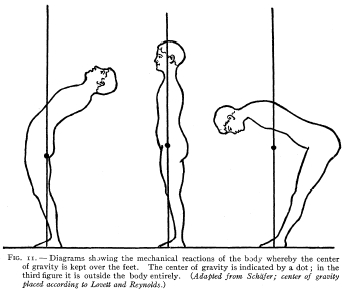
"From the time a child leaves its mother's arms and begins to stand and walk alone, there is a force with which it, in common with the rest of mankind, is always contending; this force is gravity. We are battling with this force from morning till night, yielding to it partially as opportunity offers to assume a sitting position, and finally yielding to it completely, as we do each night when we sink to rest in a horizontal position. But this force not only acts upon the body as a whole throughout the day, but upon each individual part of the body. Thus the head tends to drop forward, the shoulders to round over and droop forward, the back to curve, the chest to become flattened and compressed, the knees to bend, the arch of the foot to break down, etc. This is nature's attempt to seek an equilibrium . . . and the only way that this downward tendency can be overcome is by the constant exertion of muscular force." l Sargent, 122,
Showing posts with label brachium. Show all posts
Thursday, July 26, 2012
Isonomia and the Gravitational Vector
.... In terms of artistic anatomy, understanding where the muscles originate and insert on the bone and how these muscles exert their influence on surface anatomy, is important for communicating how the veiwer "reads" the drawing. The nervous system is constantly firing off electrical impulses to the
muscles to initiate flexion, as a way to counteract gravitational forces
exerted down through the physical body.These forces are expressed as
vectors which are channeled down through the skeleton to the earth's core or more specifically through whatever surface the body is resting on. In every movement there is a coordinated series of muscle flexion, all utilizing to various degrees the three types of levers, mechanisms of physics which describe how soft tissue can exert force across bone to achieve movement.To initiate movement through an invisible gravitational field means that the physical body,( or brain more accurately) has to coordinate how multiple muscles and groups of muscles must inititate flexion at precisely the right moment to achieve the desired movement. Very much like how retro rockets on a space craft initiate movement along a path with the precise directional pulses of rockets.
"From the time a child leaves its mother's arms and begins to stand and walk alone, there is a force with which it, in common with the rest of mankind, is always contending; this force is gravity. We are battling with this force from morning till night, yielding to it partially as opportunity offers to assume a sitting position, and finally yielding to it completely, as we do each night when we sink to rest in a horizontal position. But this force not only acts upon the body as a whole throughout the day, but upon each individual part of the body. Thus the head tends to drop forward, the shoulders to round over and droop forward, the back to curve, the chest to become flattened and compressed, the knees to bend, the arch of the foot to break down, etc. This is nature's attempt to seek an equilibrium . . . and the only way that this downward tendency can be overcome is by the constant exertion of muscular force." l Sargent, 122,
Labels:
artistic anatomy,
brachium,
Figure Drawing,
triceps
Sunday, July 15, 2012
Shoulder Girdle
The Shoulder girdle is in essence a pelvis that has evolved to allow for the brachia apparatus, i,e,. mechanical specialization of the humerus and shoulder that facilitates the the needs of the pronated hand and opposable thumb. Freed from it's primary purpose of translocation and isonomic channeling (dispersion of gravitational force) which defines the structure of the pelvis , the Sacrum ,Ilium and Ischia have now separated and the scapula takes shape- becoming the Ischia and Ilium of the shoulder. These free floating "pelvic halves"allow for a greater range of movement than a fixed pelvis could ever allow..Clearly it is evident that he pubic bone of the pelvis is analogous to the clavicle of the shoulder girdle. With a bit of imagination it can also be observed that the Coracoid Process of the Scapula is analogous to the Pubic Bone of the Pelvis.
Labels:
artistic anatomy,
biceps brachii,
brachium,
clavicle,
humerus,
scapula,
shoulder girdle
Wednesday, July 4, 2012
Biceps Brachii
This week in the Ecorche class we covered the Biceps Brachii and the adjacent musculature of the scapula...the Brachialis, the Coracobrachialis, the Pectoralis Minor , and the superior aspect of the Serratus Anterior- all assisting in the movement of the scapula and the upper arm.
Saturday, June 30, 2012
Triceps
From last weeks Ecorche class..."The Triceps"
- The primary function of the triceps is to extend the elbow, which results in straightening the arm.
- The secondary function of the triceps is fulfilled only by the long head of the muscle, which is to adduct the arm (or to bring the arm down towards the body). The triceps shares this function with the latissimus dorsi (back muscles).
Labels:
anatomy drawing,
artistic anatomy,
brachium,
ecorche,
Figure drawings,
musculature,
triceps
Tuesday, June 26, 2012
Serratus Muscles
Subscribe to:
Posts (Atom)